Saturday, January 8, 2011

Word Problem of the Week: Arraying the Troops

From The Elements of that Mathematical Art Commonly Called Algebra, Expounded in Two Books by John Kersey, 1741.

p. 70:


A General of an Army having set his Soldiers in a Square Battel, there happened to be 500 (or b) Soldiers to spare; but to increase the Square so as that its side might consist of 1 (or c) Soldier more than the Side of the former Square, there would be 29 (or d) Soldiers wanting. The Question is, to find how many Soldiers the General had in his Army.

Saturday, January 1, 2011

Word Problem of the Week: A Brandy Smuggler

From Ray’s Algebra, Part Second by Joseph Ray, 1852. p. 91:


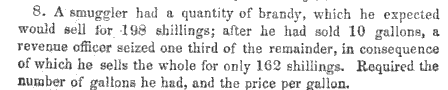
A smuggler had a quantity of brandy, which he expected would sell for 198 shillings; after he had sold 10 gallons, a revenue officer seized one third of the remainder, in consequence of which he sells the whole for only 162 shillings. Required the number of gallons he had, and the price per gallon.

My favorite part of this problem is the story we aren't getting. Why did the revenuer only confiscate a third of the brandy? My two best guesses are that the "seized" brandy was actually given to the revenuer as a bribe to ignore the rest, or that only one stash of several got raided.

This is apparently the sort of thing that seemed relevant to algebra students living at a time when the Whiskey Rebellion is in living memory.

Tuesday, December 21, 2010

Word Problem of the Week: Age of Father and Son

From Ray’s Algebra Part First by Joseph Ray, 1848.
p. 212:


If 4 be subtracted from a father's age, the remainder will be thrice the age of the son; and if 1 be taken from the son's age, half the remainder will be the square root of the father's age. Required the age of each.

Wednesday, December 15, 2010

Word Problem of the Week: Height of a May-Pole

From Pleasure With Profit: Consisting of Recreations of Divers Kinds by William Leybourne, Richard Sault, 1694, p. 35:


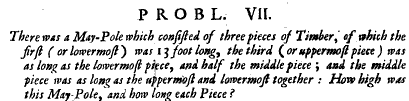
There was a May-Pole which consisted of three pieces of Timber, of which the first (or lowermost) was 13 foot long, the third (or uppermost piece) was as long as the lowermost piece, and half the middle piece; and the middle piece was as long as the uppermost and lowermost together: How high was this May-Pole, and how long each piece?


This is not the only problem in the book involving a maypole. I like how something so "Old-Europe" was apparently common enough in the 1690s to warrant mention in word problems. The height, by the way, turns out to be 104 feet. I've seen maypoles, but never one that tall.

Saturday, December 11, 2010

Calculus Made Easy

The prologue of a Calculus book from 1914:


This is still true today.

Wednesday, December 8, 2010

Word Problem of the Week

This is from An introduction to algebra; with notes and observations; designed for the use of schools and places of public education, by John Bonnycastle, 1806.

A labourer engaged to serve for 40 days upon these conditions, that for every day he worked he was to receive 20 d. but for every day he played, or was absent, he was to forfeit 8 d. now at the end of the time he had to receive 1 l. 11 s. 8 d. it is required to find how many days he worked, and how many he was idle.
One reason I love these old word problems is that they raise so many other questions than what "it is required to find." For example...

Was this labor arrangement something that actually happened, or is it an abstraction of a more subtle agreement? This is not the only time I have seen a problem like this one in an old book; it seems to have been a stock question in 19th century algebra books.

If this is the "First American Edition" then why does it still use British monetary units and spelling? Was the publisher just lazy?

Monday, November 8, 2010

Against Humanism

This article argues that Comte's attempt to create a religious humanism failed because we revere individuals and not the species. This is because individuals are the ones who change the way we view the world - greatness is an attribute of individuals.
There is no fixed, unalterable background map of the "familiar facts" that must survive all such shifts, and certainly no fixed schedule dividing real entities from fishy, imaginary ones. Entities like Fate and Progress and the Logic of History and the Hidden Hand of the Market come and go.
Unfortunately for the science of consciousness, Comte's materialism has yet to go:
The search for a "scientific explanation of consciousness" which goes on at the yearly conference at the Center for Consciousness Studies in Tuscon, Arizona still centres not on trying to be scientific in the sense of using suitable methods, but on making consciousness respectable by somehow bringing it within the range of physics and chemistry, mainly at present through neurobiology.
A real robust humanism would have to take the religious tendencies of people into account. Science isn't up to the task of myth-making:
It just works through old-fashioned personification. If there is no purpose and everything is impersonal, how can DNA be actively ruling our destinies? How can it feel "pitiless indifference" and make us "dance to its music"? The Cartesian drama of inert matter and active spirit is suddenly reversed here to show humans (and animals) as helpless objects – passive "lumbering robots" – stage-managed by plotting genes (and memes) that are sometimes helped by other entities such as market forces. The myth-building capacities that surround every new world-view are surely as busy here as they are in established religions. These visions perhaps offer the worst of both worlds – an ontology that is as bankrupt morally as it is scientifically. The imagery of science is used, not, as Huxley hoped, to ground a deep reverence for the natural world but to justify human alienation from it.