D. H. Hill, who wrote the book containing the "Bad Pork" problem, loved to put his opinions into his math problems. Later in life he was a Confederate officer, which is not a fact I had realized when I wrote that entry.
His disapproval did not end at the moral standing of the northern American character. He was also, not surprisingly, unimpressed by the nascent Women's Liberation movement. Even so, the way he characterizes the delegates of the Third National Woman's Rights Convention is so sexist it just about took my breath away (because I was laughing so hard.)
It's number 70.
Showing posts with label word problems. Show all posts
Showing posts with label word problems. Show all posts
Monday, May 21, 2012

Thursday, March 29, 2012
Word Problem(s) of the Week(s) - Meat!
Meat related Algebra Problems!
When I showed this to my students, one comment was, "There is more than one kind of bacon?"
When I showed this to my students, one comment was, "There is more than one kind of bacon?"
Monday, March 19, 2012
Word Problem of the Week: Bad Pork
One of my fundamental premises is that the themes of algebra problems bear some relationship to the life of the times when they were written. That's why this one from 1857 really caught my eye. Fraudulent practices of this type must have been fairly common in the days before the government had the strength or inclination to regulate them.
As it happens, we know what Cincinnati looked like around that time, at least near the waterfront. There are newly restored daguerreotype images of the city taken in 1848 which have exceedingly high resolution. I mean, high-end digital camera level resolution.
Some of my favorite old problems are the ones that, like this one, combine very specific detail with bizarre contrivance. In this case, the contrivance comes toward the end:
But of course, I know why he did it. He needed the equations for solving it to be of a certain type, and having the problem make a little more sense would have upset that situation.
So imagine it said that the selling price p of the pork was 12 times as much as the price c of the chemical process, each in cents per pound. Then we have that the profit, 45000 = the gain - the expenditure. The gain is simply 10000p, and the expenditure is 10000 + 10000c.
So, 45000 = 10000p - 10000c - 10000. Clear the thousands to make it 45 = 10p - 10c - 10. But since p = 12c, This becomes 45 = 120c - 10c - 10 or 55 = 110c. This makes the cost of the chemical process half a cent and the price he charges for the pork 6 cents per pound.
This is a nice little linear system problem. But setting it up the way D. H. Hill did it, you end up having to clear a denominator, making the equation quadratic and introducing an extraneous solution.
In other words, this problem sacrifices some of its plausibility to make a different, harder solution necessary.
As it happens, we know what Cincinnati looked like around that time, at least near the waterfront. There are newly restored daguerreotype images of the city taken in 1848 which have exceedingly high resolution. I mean, high-end digital camera level resolution.
Some of my favorite old problems are the ones that, like this one, combine very specific detail with bizarre contrivance. In this case, the contrivance comes toward the end:
The price at which he sold the pork per pound multiplied by the cost per pound of the chemical process was 3 cents.So, what sort of quantity is this, anyway? The unit is "dollars-squared per pound-squared" which is more than a little weird. Especially since he could have just divided the two numbers to get a dimensionless ratio.
But of course, I know why he did it. He needed the equations for solving it to be of a certain type, and having the problem make a little more sense would have upset that situation.
So imagine it said that the selling price p of the pork was 12 times as much as the price c of the chemical process, each in cents per pound. Then we have that the profit, 45000 = the gain - the expenditure. The gain is simply 10000p, and the expenditure is 10000 + 10000c.
So, 45000 = 10000p - 10000c - 10000. Clear the thousands to make it 45 = 10p - 10c - 10. But since p = 12c, This becomes 45 = 120c - 10c - 10 or 55 = 110c. This makes the cost of the chemical process half a cent and the price he charges for the pork 6 cents per pound.
This is a nice little linear system problem. But setting it up the way D. H. Hill did it, you end up having to clear a denominator, making the equation quadratic and introducing an extraneous solution.
In other words, this problem sacrifices some of its plausibility to make a different, harder solution necessary.
Wednesday, May 18, 2011
Word Problem of the Week: Unlikely Maternal Scenario
"The past is a foreign country," says the first line of The Go-Between. "They do things differently there." In the case of Gilbert Dyer's Most General School-Assistant, do they ever. On page 182, question 7, we have this amazing scenario:
There are several questions in here that say a lot about the differences we have with those in the 18th century. The next question is about a four-day family beer party and the one after that concerns, as far as I can tell, a patent medicine seller who, for some reason, is operating at a loss.
- Hodge, to inherit, must marry.
- That is, he must marry a specific person.
- His first cousin.
- And gets more money the more kids she has.
- She has 24 boys.
- In 12 years.
There are several questions in here that say a lot about the differences we have with those in the 18th century. The next question is about a four-day family beer party and the one after that concerns, as far as I can tell, a patent medicine seller who, for some reason, is operating at a loss.
Friday, April 29, 2011
Word Problem of the Week: Whiskey Rations Aboard Ship
There are two things I find interesting about this problem. First, the detail offered gives it a level of realism that is not typically found in these sorts of texts. On the other hand, the quantities are all represented as variables, which adds a level of abstraction. Thus, the answer gives us a formula for any possible scenario of this type. The problem is number 23 on page 479:
Saturday, April 16, 2011
Word Problem of the Week(s): Classical History and Mythology
These problems come from Mathematicall Recreations, or
Several of the arithmetic questions have to do thematically with the stories of ancient Greece. These are:
Of the number of Souldiers that fought before old Troy.
Of Pythagoras his Schollers.
Of the number of Apples given amongst the Graces and the Muses.
Of the Cups of Croesus. (He gave the Temple 6 golden cups weighing a total of 600 drams, with each one a dram heavier than the next.)
Of Cupid's Apples. (The Muses steal them.)
A Collection of many Problemes extracted out of the Ancient and Modern Philosophers, as Secrets and Experiments in Arithmatick, Geometry, Cosmographie, Horologiographie, Astronomie, Navigation, Musick, Opticks, Architecture, Staticks, Mechanicks, Chemistry, water-works, Fire-works, &c.Basically, a seventeenth century Dangerous Book For Boys.
Several of the arithmetic questions have to do thematically with the stories of ancient Greece. These are:
Of the number of Souldiers that fought before old Troy.
Of Pythagoras his Schollers.
Of the number of Apples given amongst the Graces and the Muses.
Of the Cups of Croesus. (He gave the Temple 6 golden cups weighing a total of 600 drams, with each one a dram heavier than the next.)
Of Cupid's Apples. (The Muses steal them.)
Wednesday, March 9, 2011
Word Problem of the Week: Map the Ohio River
It's nice to see a little connection between geometry and geography.
From Graphic Algebra, by Andrew Wheeler Phillips and William Beebe, 1904
p. 8:
![[table]](http://books.google.com/books?id=vRQUAAAAYAAJ&pg=PA8&img=1&zoom=3&hl=en&q=intitle:graphic+intitle:algebra&cds=1&sig=ACfU3U1cVtoDPY3pwEOmMcmd9Rbg1tzcsQ&edge=0&edge=stretch&w=282&h=116&ci=153,923,701,287)
This is the earliest book I have seen that emphasizes graphing equations as an algebraic tool. Then, 80 years later, the graphing calculator is invented.
From Graphic Algebra, by Andrew Wheeler Phillips and William Beebe, 1904
p. 8:
Draw a map of the Ohio River from the following latitudes and longitudes, which are reckoned from the Equator and the meridian of Washington respectively:
This is the earliest book I have seen that emphasizes graphing equations as an algebraic tool. Then, 80 years later, the graphing calculator is invented.
Thursday, March 3, 2011
Word Problem of the Week: Problem of the Lights
From Elements of Algebra, by Charles Davies, 1854.
p. 162:
"Find upon the line which joins two lights, A and B, of different intensities, the point which is equally illuminated by the lights."
This is a great little simple sounding problem that lends itself, in this case, to three and a half pages of discussion of various cases. At the end of this, the author states that "the preceding discussion presents a striking example of the precision with which the algebraic analysis responds to all the relations which exist between the quantities that enter a problem." I should say so.
p. 162:
"Find upon the line which joins two lights, A and B, of different intensities, the point which is equally illuminated by the lights."
This is a great little simple sounding problem that lends itself, in this case, to three and a half pages of discussion of various cases. At the end of this, the author states that "the preceding discussion presents a striking example of the precision with which the algebraic analysis responds to all the relations which exist between the quantities that enter a problem." I should say so.
Tuesday, February 15, 2011
Word Problem of the Week: Say, Lovely Woman, the Number of Bees.
From Lilavati, translated by Henry T. Colebrooke, 1817.
p. 211:
I highly recommend this review of the twelfth century Indian algebra text Lilavati, by Bhaskara. It references the Colebrooke Translation from 1817, which also mentions this gem from a commentary:
p. 211:
The square-root of half the number of a swarm of bees is gone to a shrub of jasmin ; and so are eight-ninths of the whole swarm : a female is buzzing to one remaining male, that is humming within a lotus, in which he is confined, having been allured to it by its fragrance at night. Say, lovely woman, the number of bees.The whole book isn't like this though; the very next problem is about a guy shooting arrows at his enemy.
I highly recommend this review of the twelfth century Indian algebra text Lilavati, by Bhaskara. It references the Colebrooke Translation from 1817, which also mentions this gem from a commentary:
Although Colebrooke refers to her as a "wench" which is a bit less romantic.
Whilst making love a necklace broke.
A row of pearls mislaid.
One third fell to the floor.
One fifth upon the bed.
The young woman saved one sixth of them.
One tenth were caught by her lover.
If six pearls remained upon the string
How many pearls were there altogether?
Thursday, February 3, 2011
Word Problem of the Week: French Degrees
I was telling the students the other day how dividing a circle into 360 pieces is a bit arbitrary. In fact, it comes from the Babylonians, and it could have been different. There is nothing special about 360.
The French, it turns out, actually did propose a different system of angular measure: one in which the fundamental unit was one percent of a right angle. Thus there are four hundred of them in one full revolution.
I remember years ago I saw a calculator with the familiar "degrees" and "radians" settings but also something called "gradians." This is the name for the "French Degrees." They are also called "grades" in a lot of old textbooks. I personally like what I called them in class, which is "People's Revolutionary Degrees."
Anyway, there seems to have been some confusion as to whether gradians were actually ever used. Some are of the opinion that the unit was "frequently used in France and ocasionally elsewhere" whereas others are convinced that they were not.
I suspect they must have been, because it is otherwise difficult to explain the enthusiasm shown for the French Degrees by a certain Mr. Isaac Todhunter. His trigonometry text is full of strange abstract problems involving equivalencies between the English and French units. Fairly typical is this one:
The French, it turns out, actually did propose a different system of angular measure: one in which the fundamental unit was one percent of a right angle. Thus there are four hundred of them in one full revolution.
I remember years ago I saw a calculator with the familiar "degrees" and "radians" settings but also something called "gradians." This is the name for the "French Degrees." They are also called "grades" in a lot of old textbooks. I personally like what I called them in class, which is "People's Revolutionary Degrees."
Anyway, there seems to have been some confusion as to whether gradians were actually ever used. Some are of the opinion that the unit was "frequently used in France and ocasionally elsewhere" whereas others are convinced that they were not.
I suspect they must have been, because it is otherwise difficult to explain the enthusiasm shown for the French Degrees by a certain Mr. Isaac Todhunter. His trigonometry text is full of strange abstract problems involving equivalencies between the English and French units. Fairly typical is this one:
Divide two-thirds of a right angle into two parts, such that the number of degrees in one part may be to the number of grades in the other part as 3 to 10.This combines the slightly obscure and uncommonly used unit with the proportionality question so common in 18th and 19th century texts to produce a masterpiece of bizarre irrelevance. Really, this is an interesting puzzle, but trig texts are usually much more practical than this.
Saturday, January 22, 2011
Word Problem of the Week: From the Notebook of Benjamin Banneker
This morning I had the pleasure of attending a talk by John Mahoney concerning his experience teaching at Benjamin Banneker Academic High School in the District of Columbia. Part of the talk concerned Banneker himself, who is a fascinating personality about whom I'm going to have to write more later.
Banneker kept a notebook in which he recorded interesting problems. This one is interesting because there is an elegant solution that is unintuitive to someone educated in the modern way. At least to me, it was unintuitive. Problems such as this seem to have been popular in the 18th century, though.

Banneker kept a notebook in which he recorded interesting problems. This one is interesting because there is an elegant solution that is unintuitive to someone educated in the modern way. At least to me, it was unintuitive. Problems such as this seem to have been popular in the 18th century, though.

Question by Elliot Geographer GeneralYou start by making a guess as to the number mentioned at the end, then adjust things based on the error you get.
Divide 60 into four Such parts, that the first being increased by 4, the Second decreased by 4, the third multiplyed by 4, the fourth part divided by 4, that the Sum, the difference, the product, and the Quotient shall be one and the Same number.
Sunday, January 16, 2011
Word Problem of the Week: Wainscoting a Gentleman's House
From A Compendium of Algebra by John Ward, 1724.
p. 51:


p. 51:
Three Joiners undertook to wainscot a Gentleman's House in 150 days. One of then (being esteem'd the best) was to have 5 s. a day for every day he work'd; another was to have 4 s. 6 d. a day, and the third was to have but 4 s. for every day we wrought.So, they all made the same amount, which makes me wonder: Is the highest-paid worker the best because he's the most efficient, or is he doing a bit of slacking off?
When the Work was finish'd, every one of them had just the same Sum of Money to receive; Quere, how many Days each of them work's? &c.
Saturday, January 8, 2011
Word Problem of the Week: Arraying the Troops
From The Elements of that Mathematical Art Commonly Called Algebra, Expounded in Two Books by John Kersey, 1741.
p. 70:

A General of an Army having set his Soldiers in a Square Battel, there happened to be 500 (or b) Soldiers to spare; but to increase the Square so as that its side might consist of 1 (or c) Soldier more than the Side of the former Square, there would be 29 (or d) Soldiers wanting. The Question is, to find how many Soldiers the General had in his Army.
p. 70:
A General of an Army having set his Soldiers in a Square Battel, there happened to be 500 (or b) Soldiers to spare; but to increase the Square so as that its side might consist of 1 (or c) Soldier more than the Side of the former Square, there would be 29 (or d) Soldiers wanting. The Question is, to find how many Soldiers the General had in his Army.
Saturday, January 1, 2011
Word Problem of the Week: A Brandy Smuggler
From Ray’s Algebra, Part Second by Joseph Ray, 1852. p. 91:
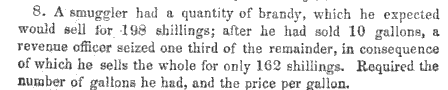
My favorite part of this problem is the story we aren't getting. Why did the revenuer only confiscate a third of the brandy? My two best guesses are that the "seized" brandy was actually given to the revenuer as a bribe to ignore the rest, or that only one stash of several got raided.
This is apparently the sort of thing that seemed relevant to algebra students living at a time when the Whiskey Rebellion is in living memory.
A smuggler had a quantity of brandy, which he expected would sell for 198 shillings; after he had sold 10 gallons, a revenue officer seized one third of the remainder, in consequence of which he sells the whole for only 162 shillings. Required the number of gallons he had, and the price per gallon.
My favorite part of this problem is the story we aren't getting. Why did the revenuer only confiscate a third of the brandy? My two best guesses are that the "seized" brandy was actually given to the revenuer as a bribe to ignore the rest, or that only one stash of several got raided.
This is apparently the sort of thing that seemed relevant to algebra students living at a time when the Whiskey Rebellion is in living memory.
Tuesday, December 21, 2010
Word Problem of the Week: Age of Father and Son
From Ray’s Algebra Part First by Joseph Ray, 1848.
p. 212:

p. 212:
If 4 be subtracted from a father's age, the remainder will be thrice the age of the son; and if 1 be taken from the son's age, half the remainder will be the square root of the father's age. Required the age of each.
Wednesday, December 15, 2010
Word Problem of the Week: Height of a May-Pole
From Pleasure With Profit: Consisting of Recreations of Divers Kinds by William Leybourne, Richard Sault, 1694, p. 35:
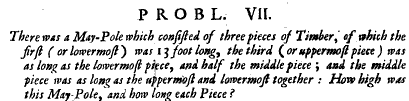
This is not the only problem in the book involving a maypole. I like how something so "Old-Europe" was apparently common enough in the 1690s to warrant mention in word problems. The height, by the way, turns out to be 104 feet. I've seen maypoles, but never one that tall.
There was a May-Pole which consisted of three pieces of Timber, of which the first (or lowermost) was 13 foot long, the third (or uppermost piece) was as long as the lowermost piece, and half the middle piece; and the middle piece was as long as the uppermost and lowermost together: How high was this May-Pole, and how long each piece?
This is not the only problem in the book involving a maypole. I like how something so "Old-Europe" was apparently common enough in the 1690s to warrant mention in word problems. The height, by the way, turns out to be 104 feet. I've seen maypoles, but never one that tall.
Wednesday, December 8, 2010
Word Problem of the Week
This is from An introduction to algebra; with notes and observations; designed for the use of schools and places of public education, by John Bonnycastle, 1806.
Was this labor arrangement something that actually happened, or is it an abstraction of a more subtle agreement? This is not the only time I have seen a problem like this one in an old book; it seems to have been a stock question in 19th century algebra books.
If this is the "First American Edition" then why does it still use British monetary units and spelling? Was the publisher just lazy?
One reason I love these old word problems is that they raise so many other questions than what "it is required to find." For example...
A labourer engaged to serve for 40 days upon these conditions, that for every day he worked he was to receive 20 d. but for every day he played, or was absent, he was to forfeit 8 d. now at the end of the time he had to receive 1 l. 11 s. 8 d. it is required to find how many days he worked, and how many he was idle.
Was this labor arrangement something that actually happened, or is it an abstraction of a more subtle agreement? This is not the only time I have seen a problem like this one in an old book; it seems to have been a stock question in 19th century algebra books.
If this is the "First American Edition" then why does it still use British monetary units and spelling? Was the publisher just lazy?
Subscribe to:
Comments (Atom)