Showing posts with label history. Show all posts

Tuesday, April 23, 2013

The Usefulness of Mathematical Learning - Part 2

Part 1

Continuing on the the second page, we find that

In all ages and countries where learning has prevailed, the mathematical sciences have been looked upon as the most considerable branch of it. The very name "Mathematician" implies no less, by which they were called either for their excellency or because of all the sciences they were first taught, or because they were judged to comprehend "all things mathematical". 

I'm no scholar of Greek, so I'm taking a bit of a liberty with what I think Arbuthnot was trying to say here. I do know that the original Greek word from which the term "mathematics" is derived has senses of meaning "what is learned." So it's not really surprising that he goes on to write

And amongst those that are commonly reckoned to be the seven Liberal Arts, four are mathematical, to wit, Arithmetic, Music, Astronomy, and Geometry.

He is referring here to the Quadrivium, which was the second course of study in the medieval university. The first was the Trivium, and consisted of Grammar, Logic and Rhetoric. Of course, contemporary people don't really think of music as a mathematical study, even though things like rhythm, pitch, tempo, and duration can all be quantified, and despite the explicitly mathematical origins of the art in the Western tradition starting with Pythagoras.

Not only that, logic actually is a branch of mathematics now, but wasn't in the 17th century. It started to be formalized as a mathematical study in a serious way by thinkers such as Boole, Pierce, and Russell.

In the next part, the author starts to describe why he thinks people don't learn math as much as they should.

But notwithstanding their excellency and reputation, they have not been taught nor studied so universally as some of the rest, which I take to have proceeded from the following causes:

The reasons he gives all sound very modern: people don't like to think so hard, they don't realize how useful math is, they think that only geniuses can learn it, it is not encouraged, and there aren't enough good teachers.

Wednesday, April 17, 2013

The Usefulness of Mathematical Learning - Part 1

I have, for quite some time, admired "An Essay on the Usefulness of Mathematical Learning in a Letter from a Gentleman in the City to his Friend in Oxford."

Though it was first printed in 1701, the arguments it makes are remarkably modern sounding - possibly because the time we live in actually has a lot in common with the late 17th and early 18th centuries.

So I think that this book is worth reading, but the format, typesetting, and 17th century usage make it tricky. Therefore, I will transcribe it into slightly more modern English while doing my best to preserve the tone and rhythm of the prose. Also, I mean to offer such commentary as may be useful to a student who endeavors to fully comprehend the import of the argument.

I think I'm in the spirit now, so here we go.

AN

ESSAY

ON

The Usefulness of

MATHEMATICAL LEARNING, &c.

Sir,

I am glad to hear from you that the study of the Mathematics is promoted and encouraged among the youth of your university. The great influence, which these sciences have on Philosophy and all useful learning, as well as the concerns of the public, may sufficiently recommend them to your choice and consideration: and the particular advantages, which you of that place enjoy, give us just reason to expect from you a suitable improvement in them. I have here sent you some short reflections upon the usefulness of mathematical learning which may serve as an argument to incite you to a closer and more vigorous pursuit of it.

Thursday, March 29, 2012

Word Problem(s) of the Week(s) - Meat!

Meat related Algebra Problems!

When I showed this to my students, one comment was, "There is more than one kind of bacon?"

Monday, March 19, 2012

Word Problem of the Week: Bad Pork

One of my fundamental premises is that the themes of algebra problems bear some relationship to the life of the times when they were written. That's why this one from 1857 really caught my eye. Fraudulent practices of this type must have been fairly common in the days before the government had the strength or inclination to regulate them.

As it happens, we know what Cincinnati looked like around that time, at least near the waterfront. There are newly restored daguerreotype images of the city taken in 1848 which have exceedingly high resolution. I mean, high-end digital camera level resolution.

Some of my favorite old problems are the ones that, like this one, combine very specific detail with bizarre contrivance. In this case, the contrivance comes toward the end:
The price at which he sold the pork per pound multiplied by the cost per pound of the chemical process was 3 cents.
 So, what sort of quantity is this, anyway? The unit is "dollars-squared per pound-squared" which is more than a little weird. Especially since he could have just divided the two numbers to get a dimensionless ratio.

But of course, I know why he did it. He needed the equations for solving it to be of a certain type, and having the problem make a little more sense would have upset that situation.

So imagine it said that the selling price p of the pork was 12 times as much as the price c of the chemical process, each in cents per pound. Then we have that the profit, 45000 = the gain - the expenditure. The gain is simply 10000p, and the expenditure is 10000 + 10000c.

So, 45000 = 10000p - 10000c - 10000. Clear the thousands to make it 45 = 10p - 10c - 10. But since p = 12c, This becomes 45 = 120c - 10c - 10 or 55 = 110c. This makes the cost of the chemical process half a cent and the price he charges for the pork 6 cents per pound.

This is a nice little linear system problem. But setting it up the way D. H. Hill did it, you end up having to clear a denominator, making the equation quadratic and introducing an extraneous solution.

In other words, this problem sacrifices some of its plausibility to make a different, harder solution necessary.

Tuesday, September 20, 2011

Worse than Meaningless

Worst Graph of the Year. If it was completely devoid of any information, it would be a whole lot better, simply because it wouldn't be shockingly historically inaccurate and blatantly propagandistic. I also wonder what the units are for "militancy." Apparently the person who didn't label the axis doesn't know either. Relationships have ended for less.

Thursday, August 18, 2011

Henry VIII


A jolly comic!


Wednesday, May 18, 2011

Word Problem of the Week: Unlikely Maternal Scenario

"The past is a foreign country," says the first line of The Go-Between. "They do things differently there." In the case of Gilbert Dyer's Most General School-Assistant, do they ever. On page 182, question 7, we have this amazing scenario:
  • Hodge, to inherit, must marry.
  • That is, he must marry a specific person.
  • His first cousin.
  • And gets more money the more kids she has.
  • She has 24 boys.
  • In 12 years.
Now, I think everyone expects algebra problems to be a bit contrived, possibly to abstract out some real life detail for the sake of the simplicity of the solution. Dyer certainly does this. But something about the little details he does include, makes me find this hilarious. Hodge is honest, Polly is pretty, and they start having kids "honestly, one Year after Marriage."

There are several questions in here that say a lot about the differences we have with those in the 18th century. The next question is about a four-day family beer party and the one after that concerns, as far as I can tell, a patent medicine seller who, for some reason, is operating at a loss.

Saturday, April 16, 2011

Word Problem of the Week(s): Classical History and Mythology

These problems come from Mathematicall Recreations, or
A Collection of many Problemes extracted out of the Ancient and Modern Philosophers, as Secrets and Experiments in Arithmatick, Geometry, Cosmographie, Horologiographie, Astronomie, Navigation, Musick, Opticks, Architecture, Staticks, Mechanicks, Chemistry, water-works, Fire-works, &c.
Basically, a seventeenth century Dangerous Book For Boys.

Several of the arithmetic questions have to do thematically with the stories of ancient Greece. These are:
Of the number of Souldiers that fought before old Troy.
Of Pythagoras his Schollers.
Of the number of Apples given amongst the Graces and the Muses.
Of the Cups of Croesus. (He gave the Temple 6 golden cups weighing a total of 600 drams, with each one a dram heavier than the next.)
Of Cupid's Apples.
(The Muses steal them.)

Tuesday, February 15, 2011

Word Problem of the Week: Say, Lovely Woman, the Number of Bees.

From Lilavati, translated by Henry T. Colebrooke, 1817.
p. 211:
The square-root of half the number of a swarm of bees is gone to a shrub of jasmin ; and so are eight-ninths of the whole swarm : a female is buzzing to one remaining male, that is humming within a lotus, in which he is confined, having been allured to it by its fragrance at night. Say, lovely woman, the number of bees.
The whole book isn't like this though; the very next problem is about a guy shooting arrows at his enemy.

I highly recommend this review of the twelfth century Indian algebra text Lilavati, by Bhaskara. It references the Colebrooke Translation from 1817, which also mentions this gem from a commentary:

Whilst making love a necklace broke.
A row of pearls mislaid.
One third fell to the floor.
One fifth upon the bed.
The young woman saved one sixth of them.
One tenth were caught by her lover.
If six pearls remained upon the string
How many pearls were there altogether?
Although Colebrooke refers to her as a "wench" which is a bit less romantic.

Thursday, February 3, 2011

Word Problem of the Week: French Degrees

I was telling the students the other day how dividing a circle into 360 pieces is a bit arbitrary. In fact, it comes from the Babylonians, and it could have been different. There is nothing special about 360.

The French, it turns out, actually did propose a different system of angular measure: one in which the fundamental unit was one percent of a right angle. Thus there are four hundred of them in one full revolution.

I remember years ago I saw a calculator with the familiar "degrees" and "radians" settings but also something called "gradians." This is the name for the "French Degrees." They are also called "grades" in a lot of old textbooks. I personally like what I called them in class, which is "People's Revolutionary Degrees."

Anyway, there seems to have been some confusion as to whether gradians were actually ever used. Some are of the opinion that the unit was "frequently used in France and ocasionally elsewhere" whereas others are convinced that they were not.

I suspect they must have been, because it is otherwise difficult to explain the enthusiasm shown for the French Degrees by a certain Mr. Isaac Todhunter. His trigonometry text is full of strange abstract problems involving equivalencies between the English and French units. Fairly typical is this one:
Divide two-thirds of a right angle into two parts, such that the number of degrees in one part may be to the number of grades in the other part as 3 to 10.
This combines the slightly obscure and uncommonly used unit with the proportionality question so common in 18th and 19th century texts to produce a masterpiece of bizarre irrelevance. Really, this is an interesting puzzle, but trig texts are usually much more practical than this.

Saturday, January 22, 2011

Word Problem of the Week: From the Notebook of Benjamin Banneker

This morning I had the pleasure of attending a talk by John Mahoney concerning his experience teaching at Benjamin Banneker Academic High School in the District of Columbia. Part of the talk concerned Banneker himself, who is a fascinating personality about whom I'm going to have to write more later.

Banneker kept a notebook in which he recorded interesting problems. This one is interesting because there is an elegant solution that is unintuitive to someone educated in the modern way. At least to me, it was unintuitive. Problems such as this seem to have been popular in the 18th century, though.

Question by Elliot Geographer General
Divide 60 into four Such parts, that the first being increased by 4, the Second decreased by 4, the third multiplyed by 4, the fourth part divided by 4, that the Sum, the difference, the product, and the Quotient shall be one and the Same number.
You start by making a guess as to the number mentioned at the end, then adjust things based on the error you get.

Sunday, January 16, 2011

Word Problem of the Week: Wainscoting a Gentleman's House

From A Compendium of Algebra by John Ward, 1724.

p. 51:

Three Joiners undertook to wainscot a Gentleman's House in 150 days. One of then (being esteem'd the best) was to have 5 s. a day for every day he work'd; another was to have 4 s. 6 d. a day, and the third was to have but 4 s. for every day we wrought.
When the Work was finish'd, every one of them had just the same Sum of Money to receive; Quere, how many Days each of them work's? &c.
So, they all made the same amount, which makes me wonder: Is the highest-paid worker the best because he's the most efficient, or is he doing a bit of slacking off?

Saturday, January 8, 2011

Word Problem of the Week: Arraying the Troops

From The Elements of that Mathematical Art Commonly Called Algebra, Expounded in Two Books by John Kersey, 1741.

p. 70:


A General of an Army having set his Soldiers in a Square Battel, there happened to be 500 (or b) Soldiers to spare; but to increase the Square so as that its side might consist of 1 (or c) Soldier more than the Side of the former Square, there would be 29 (or d) Soldiers wanting. The Question is, to find how many Soldiers the General had in his Army.

Saturday, January 1, 2011

Word Problem of the Week: A Brandy Smuggler

From Ray’s Algebra, Part Second by Joseph Ray, 1852. p. 91:


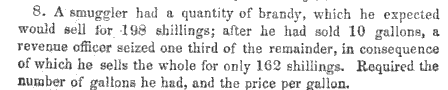
A smuggler had a quantity of brandy, which he expected would sell for 198 shillings; after he had sold 10 gallons, a revenue officer seized one third of the remainder, in consequence of which he sells the whole for only 162 shillings. Required the number of gallons he had, and the price per gallon.

My favorite part of this problem is the story we aren't getting. Why did the revenuer only confiscate a third of the brandy? My two best guesses are that the "seized" brandy was actually given to the revenuer as a bribe to ignore the rest, or that only one stash of several got raided.

This is apparently the sort of thing that seemed relevant to algebra students living at a time when the Whiskey Rebellion is in living memory.

Tuesday, December 21, 2010

Word Problem of the Week: Age of Father and Son

From Ray’s Algebra Part First by Joseph Ray, 1848.
p. 212:


If 4 be subtracted from a father's age, the remainder will be thrice the age of the son; and if 1 be taken from the son's age, half the remainder will be the square root of the father's age. Required the age of each.

Wednesday, December 15, 2010

Word Problem of the Week: Height of a May-Pole

From Pleasure With Profit: Consisting of Recreations of Divers Kinds by William Leybourne, Richard Sault, 1694, p. 35:


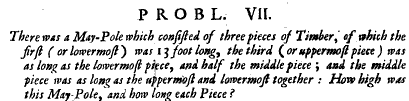
There was a May-Pole which consisted of three pieces of Timber, of which the first (or lowermost) was 13 foot long, the third (or uppermost piece) was as long as the lowermost piece, and half the middle piece; and the middle piece was as long as the uppermost and lowermost together: How high was this May-Pole, and how long each piece?


This is not the only problem in the book involving a maypole. I like how something so "Old-Europe" was apparently common enough in the 1690s to warrant mention in word problems. The height, by the way, turns out to be 104 feet. I've seen maypoles, but never one that tall.

Saturday, December 11, 2010

Calculus Made Easy

The prologue of a Calculus book from 1914:


This is still true today.

Wednesday, December 8, 2010

Word Problem of the Week

This is from An introduction to algebra; with notes and observations; designed for the use of schools and places of public education, by John Bonnycastle, 1806.

A labourer engaged to serve for 40 days upon these conditions, that for every day he worked he was to receive 20 d. but for every day he played, or was absent, he was to forfeit 8 d. now at the end of the time he had to receive 1 l. 11 s. 8 d. it is required to find how many days he worked, and how many he was idle.
One reason I love these old word problems is that they raise so many other questions than what "it is required to find." For example...

Was this labor arrangement something that actually happened, or is it an abstraction of a more subtle agreement? This is not the only time I have seen a problem like this one in an old book; it seems to have been a stock question in 19th century algebra books.

If this is the "First American Edition" then why does it still use British monetary units and spelling? Was the publisher just lazy?

Wednesday, November 11, 2009

James Joseph Sylvester: Mathematitian and "poet".

There is a rather interesting transcribed speech here which discusses the poetical efforts of J. J. Sylvester, who was the first Jew to hold a professorship at Oxford. In particular, as mentioned by Bell, he wrote a poem called, "To a missing member of a family of terms in an algebraical formula" which starts as such:
Lone and discarded one! divorced by fate,
From thy wished-for fellows--whither art flown?
Where lingerest thou in thy bereaved estate,
Like some lost star or buried meteor stone?
So yeah, his math was better than his poetry.

Saturday, November 7, 2009

What I'm Reading: Men of Mathematics

Men of Mathematics by Eric Temple Bell is a collection of personal and professional biographies of thirty great mathematicians. The first three are from ancient Greece: Zeno, Eudoxus, and Archimedes. The others are from the seventeenth to nineteenth centuries, from Descartes to Cantor.

It was written in 1937, which shows. Not just when the author refers to Bertrand Russell in the present tense, but also, for example, when he mentions in the introduction that certain "writers and artists (some from Hollywood)" have been interested in "how many of the great mathematicians have been perverts." ("None.")

The great thing about this book is the richness of detail Bell gives in the details of the subjects' personal lives. One gets the sense that Bell cares for the mathematicians personally, and also that there is a distinct lack of objectivity here. Gauss in particular is the recipient of torrents of praise. Anyone who opposed or insulted him, or who he disliked, is savaged, usually hilariously.

For example, Napoleon apparently once told Laplace that he would read his book "the first free month he could find." Bell, after relating this, proceeds to write that "Newton and Gauss might have been equal to the task; Napoleon no doubt could have turned the pages in his month without greatly tiring himself."

Later in the chapter, Bell mentions that Gauss didn't like Lord Byron, then goes on to describe the poet in terms of "posturing", "reiterated world-weariness", "affected misanthropy", and "histrionics". He then points out that "no man who guzzled good brandy and pretty women as assiduously as Byron did could be so very weary of the world as the naughty young poet with the flashing eye and the shaking hand pretended to be."

Right now, I'm on the chapter about William Hamilton. It starts with relating that when Hamilton was thirteen he knew a language for every year of his life. Bell does not approve. ("Good God! What was the sense of it all?") At fourteen he wrote a letter of welcome to the Persian Ambassador, in Persian, which Bell imagines may have been responsible for the Ambassador giving an excuse to avoid meeting him. According to an article of Nature (from 1883!) I found on Google Books, it read like this:

As the heart of the worshiper is turned towards the altar of his sacred vision, and as the sunflower to the rays of the sun, so to thy polished radiance turns expanding itself the yet unblossomed rosebud of my mind, desiring warmer climates whose fragrancy and glorious splendor appear to warm and embalm the orbit about thee, the Star of the State, of brilliant lustre.

The article says it was received warmly.

So all in all, this book is amusing and a good read for those interested in the personalities behind the major mathematical discoveries of the seventeenth to nineteenth centuries. But while Bell was an accomplished mathematician in his own right, Men of Mathematics is in large part a work of opinion, and does not in all cases possess the rigor that history is capable of having.